What is polyurethane foam leveling and when is it the right choice?
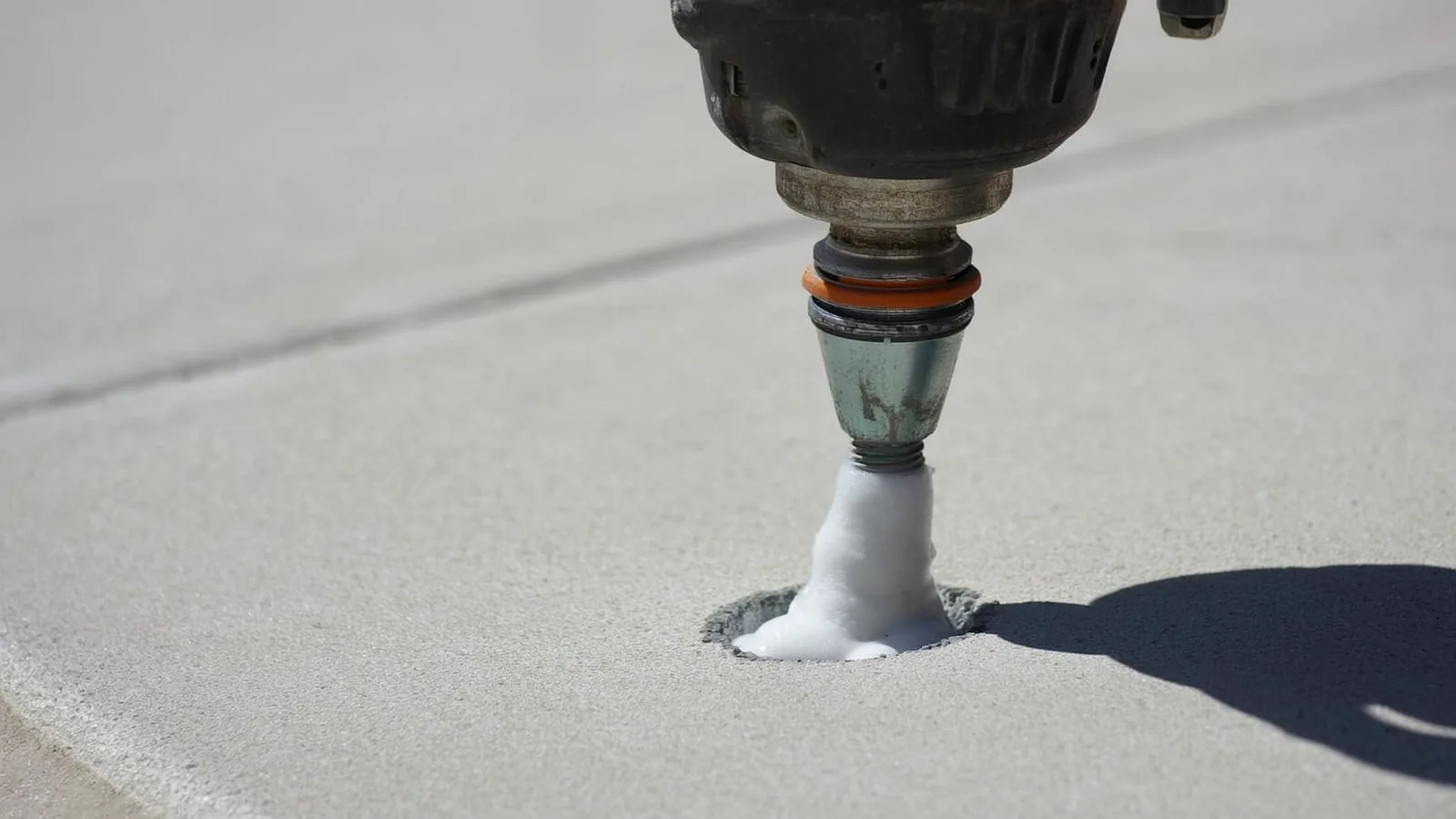
Polyurethane foam leveling is a concrete repair process in which a contractor drills small holes through a settled slab and injects a two-part expanding polymer foam into the void beneath. The foam reacts chemically within seconds, expands to fill the empty space, and lifts the slab back toward its original elevation. Within 15 to 30 minutes the surface can typically handle foot or vehicle traffic again. For Knox County homeowners dealing with a sunken driveway apron, a tilted sidewalk panel, or a settled garage floor, the method offers a faster return to service than nearly any alternative.
How it works mechanically
When water erodes the subgrade beneath a concrete slab, or when Knox County’s clay-rich valley soils shrink during dry periods, a void forms. The slab then sags into that void under its own weight. Polyurethane foam leveling addresses the problem from the underside. A technician drills holes roughly 5/8 inch in diameter at calculated injection points, inserts a nozzle, and pumps the two-part liquid into the void space. The expanding foam flows into irregular cavities, bonds to the concrete above, and cures into a lightweight but load-bearing solid. The result is a slab that is both lifted and supported by a new substrate.
The conditions it is designed for
Polyurethane foam leveling performs well on settled flatwork, driveways, sidewalks, garage floors, pool decks, and patio slabs, where the concrete itself is structurally sound but the subgrade has lost density or developed voids. Knox County’s documented karst limestone geology makes void formation a real concern; solution cavities beneath flatwork are not rare here, and foam’s ability to flow into irregular spaces is a practical advantage over denser fill materials. The method is also a reasonable first response when soil erosion under a slab is the cause of settlement and the surrounding drainage has since been corrected.
When an alternative is the better choice
Foam leveling is not a foundation underpinning method. If the structure showing signs of settlement is a home’s poured concrete or block foundation wall, or if a crawl-space or basement footing is losing bearing capacity, helical piers or push piers designed for structural underpinning provide a depth of support that foam injection cannot match. Foam is also a poor fit when the void beneath a slab is actively growing due to a large subsurface karst cavity. In those situations, the correct first step is a geotechnical evaluation, not a surface repair. If your concern involves cracks in the home’s foundation walls rather than settled flatwork, the page covering foundation wall crack patterns and their causes explains what to look for.
Installation process
Polyurethane foam leveling is one of the faster repair methods available for settled flatwork. A typical residential driveway or walkway project can be completed in two to six hours by a two-person crew.
Step 1: Site assessment and layout (30-60 minutes)
The technician walks the settled area, probes for soft spots, and marks injection point locations. On Knox County projects the technician should also note whether the lot sits in a valley position, which concentrates stormwater runoff and is a common driver of subgrade erosion. If the slab shows signs of settlement over a significant void, the contractor may probe with a thin rod to gauge cavity depth before drilling.
Step 2: Drilling injection holes (15-30 minutes)
A rotary hammer drill bores 5/8-inch holes through the slab at the marked points. Hole spacing is typically every two to three feet along the settled section. Dust from the drilling is contained with a vacuum shroud in most professional setups. No heavy equipment is required on the lawn or in the garage; the injection rig is cart-mounted or carried in from a service van.
Step 3: Foam injection and lift (varies by project size)
The technician inserts a mixing nozzle, pumps two-part liquid polymer through it, and monitors the slab surface for movement. Lift happens quickly. Over-injection is the most common installer error, so experienced technicians inject in short bursts, pause to let the foam reach full expansion, and re-evaluate elevation before continuing. Where a slab has multiple panels settled at different angles, the technician works methodically across zones to avoid cracking the concrete by lifting unevenly.
Step 4: Cure and hole patching (15-30 minutes)
The foam reaches functional cure strength within minutes. Once the technician confirms target elevation, the injection holes are cleaned and patched with a fast-setting cementitious mortar. The patch color rarely matches the surrounding concrete exactly, particularly on weathered driveways, so discuss appearance expectations in advance. Most crews can drive on the repaired section within half an hour of completing the patch.
Step 5: Cleanup and final inspection
The crew removes drilling debris, checks joint alignment, and walks the homeowner through the repaired area. There is no standing equipment, no wet slurry to cure, and no concrete washout. A well-run job leaves little evidence of work beyond the patched holes.
Polyurethane foam leveling vs. mudjacking
Both methods address the same underlying problem: a concrete slab that has lost subgrade support. The choice between them comes down to soil type, access, urgency, and the specific conditions beneath the slab.
Mudjacking pumps a slurry of cement, soil, and water under the slab through larger holes, typically 1.5 to 2 inches in diameter. The slurry is denser and heavier than foam, which creates a liability on soft or erosion-prone subgrades. In Knox County’s valley positions, where silty clay soils have already shown they cannot support the original slab load without settling, pumping heavy slurry beneath the same slab can accelerate future movement. Polyurethane foam, by contrast, adds almost no weight to the subgrade. That property matters here.
On Knox County’s karst soils, foam has a second advantage. Mudjacking slurry requires a contained void to fill; if the cavity beneath the slab connects to a subsurface drainage channel (which karst systems can create), the slurry may flow away and provide no lift. Expanding foam fills irregular voids and seals against further water infiltration. For homeowners in karst-mapped areas of the county, that is a meaningful distinction.
Mudjacking’s main advantage is cost. Material costs for slurry are lower than for two-part polymer foam, and the price difference can be significant on large projects. For a wide patio or a long driveway apron where the subgrade is stable sand or compacted fill rather than expansive clay, mudjacking may provide comparable long-term results at a lower price. The mudjacking service page covering Knoxville walks through those cases in detail.
The honest summary: choose polyurethane foam when speed, low added weight, and the ability to fill irregular voids are priorities. Choose mudjacking when the subgrade is suitable, the project is large, and budget is the primary constraint.
Polyurethane foam leveling cost in Knoxville, TN
Bob Vila’s foundation repair cost guide reports mudjacking at $500 to $1,300 and notes that polyurethane foam leveling typically runs higher per square foot because of material cost, though the smaller crew requirement and faster job completion can narrow the total-project gap. This Old House separately reports an average foundation repair cost of around $4,500 with a typical range of $2,000 to $7,500, a window that covers more complex flatwork leveling projects with drainage correction.
For a straightforward residential project in the Knoxville market, the following local variables move the number:
Number of injection points. Contractors usually price by the hole or by the lift zone. A settled two-car driveway apron may require 20 to 30 injection points. A single sidewalk panel may need six.
Depth to the void. A shallow void just beneath the slab requires less material than a deep cavity. Knox County’s karst geology occasionally produces deeper-than-expected voids, which can increase material volume and cost.
Site access. Foam equipment is compact, but if the settled slab is in a backyard behind a narrow gate, hand-carrying equipment adds labor time. Rear-lot slabs and pool decks in hilly West Knox neighborhoods sometimes carry an access surcharge.
Whether drainage correction is included. If the settled slab is in a spot that continues to flood during Knoxville’s roughly 48 inches of annual rainfall (NWS Morristown KMRX, 1991-2020 Climate Normals), re-leveling without fixing the drainage problem is a temporary fix. Some contractors bundle drainage grading into the scope; others price it separately.
For a project-specific number, request a free inspection and written estimate for your Knoxville property. You can also find a fuller breakdown of what drives per-project costs on the polyurethane foam leveling cost page for Knoxville.
Warranty and transferability
A quality polyurethane foam leveling warranty covers two things: the foam material itself and the workmanship of the installation. Material warranties from reputable polymer manufacturers are generally long, often 10 years or more, because the foam does not biodegrade quickly under normal conditions. The workmanship warranty, which covers re-leveling if the slab resettles due to installation error, varies more widely across contractors and is the number to pay closest attention to.
For residential flatwork in the Knoxville market, a reasonable workmanship warranty runs two to five years. Some contractors offer longer terms, which is worth asking about when comparing bids.
Transferability matters if you plan to sell. A transferable warranty converts a repaired slab from a potential inspection red flag into a documented, warranted asset. Ask the contractor explicitly whether the warranty transfers to a new owner and whether any conditions apply (such as the homeowner maintaining gutters and downspout extensions to protect the subgrade).
One warranty condition to watch: some contractors write drainage correction as a prerequisite. If the warranty is voided if the drainage problem that caused the original settlement is not corrected, that exclusion should be disclosed before you sign. Read the warranty document, not just the sales pitch.
Permits and engineering in Knoxville
Most polyurethane foam leveling projects on residential flatwork do not require a building permit in Knox County. Cosmetic leveling of a driveway, sidewalk, or patio falls below the threshold that triggers Knox County Department of Engineering and Public Works permit requirements under Tennessee’s statewide building code framework. Tennessee follows the International Residential Code (IRC) under TCA 68-120-101 and Rule 0780-2-2 as administered by the Tennessee Department of Commerce and Insurance.
The permit question changes if the scope of work includes structural foundation elements. If foam injection is being considered for a slab-on-grade that is part of a load-bearing foundation assembly, or if a contractor is proposing foam as void-fill beneath a structural footing, a permit is very likely required and a licensed geotechnical engineer should review the plan.
For projects where Knox County’s karst geology introduces uncertainty about void size or extent, an engineering consultation before repair is money well spent. The county’s documented sinkhole activity means that what looks like routine slab settlement can occasionally indicate a subsurface problem that foam alone will not solve. A structural or geotechnical engineer can distinguish between the two.
City of Knoxville permit questions (for properties inside city limits) go to Knoxville’s Department of Development Services. Properties in unincorporated Knox County fall under the Knox County Department of Engineering and Public Works. If you are unsure which jurisdiction applies to your address, the contractor pulling the permit should confirm before work begins.
To get eyes on your specific situation, schedule a no-obligation inspection with a Knoxville-area contractor or review the full list of foundation repair services available across the Knoxville metro service area.