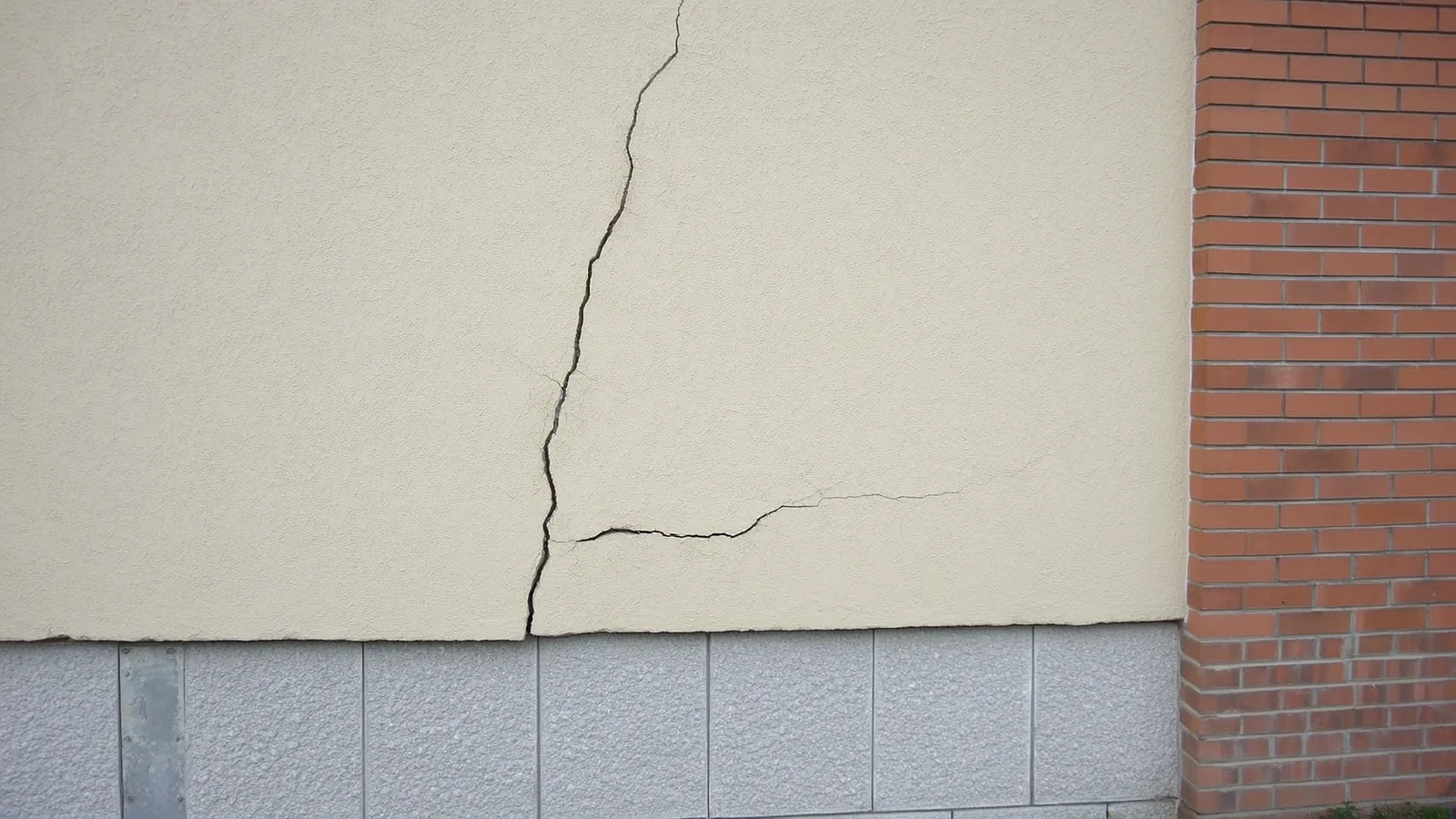
What foundation cracks look like (and when to act)
Foundation cracks show up in several forms, and the shape of the crack tells a lot about its cause before any contractor sets foot on your property.
What the crack looks like exactly
Vertical cracks run straight up and down or within 30 degrees of vertical. They are the most common crack type and often result from concrete curing or minor differential settlement. Thin hairline vertical cracks (under 1/8 inch wide) that are stable and dry are generally lower priority.
Diagonal or stair-step cracks angle across poured concrete or follow the mortar joints of a block wall in a stair-step pattern. They almost always indicate differential settlement: one end of the foundation is dropping faster than the other. In Knoxville homes, this pattern frequently traces to the Valley-and-Ridge terrain that drains stormwater unevenly, leaving one corner of a foundation in consistently wetter soil.
Horizontal cracks run parallel to the ground, usually near the mid-point of a basement or crawl-space wall. They are a structural red flag. Saturated clay soil or hydrostatic pressure from Knox County’s karst-limestone drainage patterns pushes laterally against the wall; if that force exceeds the wall’s capacity, horizontal cracking is the first sign before inward bowing begins.
Shear cracks appear as paired diagonal cracks or cracks that show one side of the wall displaced up or sideways relative to the other. They indicate significant foundation movement and require immediate evaluation.
Monitor vs. act now
Monitor when: a vertical crack is less than 1/8 inch wide, dry, not actively widening, and appeared shortly after the home was built (common during initial curing and first-year settlement). Mark both ends with a pencil date and width measurement, then re-check every 30 to 60 days.
Act now when: any crack is wider than 1/4 inch, is actively growing, has one side displaced vertically or horizontally from the other, lets water into the basement or crawl space, or is horizontal. Also act immediately if you notice doors or windows sticking, floors sloping, or drywall cracks appearing at the same time foundation cracks are present. These secondary symptoms confirm the structure is moving.
What NOT to do
Do not apply caulk, hydraulic cement, or masonry paint over a crack you haven’t had evaluated. Sealing an active crack traps moisture inside and masks the symptom, so you (and a future buyer) can’t tell whether it’s getting worse. Cosmetic patching does nothing to stop the underlying soil movement causing the crack.
What causes foundation cracks in Knoxville, TN
Knoxville’s foundation environment is more complicated than most Tennessee markets, and that complexity shows up in crack patterns that homeowners often find puzzling.
The primary soil in Knox County’s valley positions is residual clay and silty clay derived from weathered limestone, dolomite, and shale (USDA Web Soil Survey, Knox County). That clay has moderate-to-high shrink-swell potential. With nearly 48 inches of annual rainfall (NWS Morristown climate normals, 1991-2020), the clay absorbs moisture and expands during wet months, then contracts as summer heat pulls soil moisture away. This cycle repeats every year, and each cycle pushes and pulls on footings and foundation walls. Over decades, the cumulative movement causes differential settlement and cracking.
What makes Knoxville distinct from Chattanooga or Huntsville is the karst limestone bedrock mapped extensively across Knox County (Tennessee Geological Survey karst mapping). Karst terrain develops solution cavities and voids beneath the surface as slightly acidic groundwater slowly dissolves limestone over centuries. When a void migrates upward or a soil arch above it collapses, the surface (and anything sitting on it) subsides suddenly. A foundation sitting above an undetected solution cavity can crack acutely in a way that looks nothing like the gradual stair-step cracking from clay settlement. This acute displacement is why helical piers driven to competent bedrock are frequently the preferred repair method in Knox County: shallow repairs that don’t reach solid rock can fail when a void migrates.
Knox County’s Valley-and-Ridge terrain adds a third layer. Hillside and ridge-position homes can rest on shallow bedrock on the uphill side and deeper clay fill on the downhill side, creating uneven bearing from day one. Valley-position homes concentrate runoff from surrounding slopes, keeping soils saturated during rain events and encouraging hydrostatic pressure against basement and crawl-space walls. The remnants of Hurricane Helene in September 2024 illustrated this dramatically, with saturation-driven failures across East Tennessee that exposed long-developing foundation problems in a matter of days.
Knoxville’s housing stock skews old. The median construction year sits around 1974, and roughly 12 percent of city homes predate the 1940s (Wikipedia: Knoxville, Tennessee). Original foundations from that era were often built to standards that did not anticipate decades of shrink-swell cycling or the soil investigation now expected for karst areas. Many older crawl-space foundations built on pier-and-beam systems have experienced decades of wood deterioration and gradual footing settlement without any intervention.
Repair methods that address foundation cracks
The right repair method depends on what is causing the crack, not just what the crack looks like. A contractor who recommends the same fix for every crack without diagnosing the cause is not doing their job.
Crack injection
For cracks that result from concrete curing or minor historic settlement that is no longer active, epoxy or polyurethane crack injection seals the crack from the inside out. Epoxy injection bonds the two sides of the crack back together, restoring tensile strength. Polyurethane foam expands to fill irregular voids and is flexible enough to tolerate minor movement. Injection does not address ongoing settlement. It is appropriate only when a structural evaluation confirms the foundation has stopped moving.
Carbon fiber straps
Horizontal cracks and early-stage bowing walls are candidates for carbon fiber wall reinforcement straps. Straps are bonded vertically across the affected wall section and anchor to the floor and the rim joist above. They prevent further inward movement and, in some systems, allow gradual wall recovery over time. Carbon fiber straps are low-profile, do not require excavation, and leave the wall functional for storage or finishing.
Helical piers
When differential settlement is the source of cracking, the foundation needs to be stabilized at a deeper, more competent bearing layer. Helical piers are steel shafts with helical plates that are hydraulically screwed into the ground through the existing footing. In Knox County’s karst environment, piers are driven until they reach bedrock torque specifications, bypassing the problematic shrink-swell clay and any near-surface voids. Helical piers can be installed in tight crawl spaces, work in most weather conditions, and are load-tested during installation. They are frequently paired with foundation lifting to recover some of the lost elevation before cracks are injected.
Push piers
Push piers accomplish the same goal as helical piers through a different installation method. Cylindrical steel pipe sections are hydraulically driven downward through a bracket attached to the existing footing, using the weight of the structure as reaction force. They reach competent bearing and are then locked in place to stabilize (and sometimes lift) the foundation. Push piers are particularly efficient on heavier structures where soil conditions allow driven installation without pre-augering.
Typical cost range
According to Bob Vila’s foundation repair cost guide, crack injection runs $250 to $800 per crack. Piering or underpinning work costs $1,000 to $3,000 per pier installed, and wall stabilization or reinforcement ranges from $4,000 to $12,000 depending on the extent of wall damage. Bob Vila reports the overall national average for foundation repair at $5,001, with a typical range of $2,176 to $7,833.
Knoxville-specific factors that can push costs toward the higher end of these ranges include karst conditions requiring piers to be driven deeper to reach competent bedrock, restricted access in older crawl-space homes with low clearance, and situations where multiple repair methods are needed together (for example, wall stabilization combined with pier installation to address both bowing and settlement simultaneously).
For a breakdown of costs by repair type and a way to compare quotes, see the foundation repair cost guide.
What a free inspection looks for
A thorough inspection of foundation cracks is not a visual walk-around with a clipboard. A qualified contractor will take elevation measurements across multiple floor points to map where settlement has occurred and how much. They will measure crack widths with a crack comparator card and photograph each crack with a reference scale.
The inspector will look for secondary evidence: door frames that are out of square, windows that no longer open or close properly, gaps between interior walls and ceilings, and sloping floors. These corroborating symptoms help distinguish active settlement from historic cracking that resolved on its own.
In Knoxville, a thorough inspection also considers the property’s position in the Valley-and-Ridge landscape. Is the home at a valley bottom where runoff concentrates? Are there signs of surface depressions or soil subsidence near the foundation perimeter that might hint at a subsurface void? Karst-aware contractors will note these signs and may recommend a more detailed geotechnical review if acute subsidence is suspected.
Crack-width tell-tales (small plaster tabs or adhesive markers bridging the crack) may be left in place and checked at a follow-up visit if the inspector suspects active movement but needs more data before recommending a repair scope.
For a no-obligation assessment of your cracks, schedule a free inspection.
When to skip repair (or wait)
Not every crack requires an immediate repair contract. Hairline vertical cracks under 1/16 inch wide in poured concrete walls are common in the first five years after construction. Concrete shrinks as it cures, and minor cracking is an expected byproduct of that process. If the crack is stable, dry, and not accompanied by any secondary symptoms (sticking doors, sloping floors, displaced wall sides), monitoring with marked endpoints every 30 to 60 days is a reasonable first step.
Similarly, stucco or parging applied over a block foundation often develops surface crazing or small cracks that are entirely cosmetic. The parging is not a structural element, and cracking in it does not automatically mean the block behind it is compromised.
A crack is a candidate for monitoring rather than immediate repair when all of the following apply: it is less than 1/8 inch wide, it is dry, it shows no vertical or horizontal displacement between sides, and a structural evaluation confirms no measurable differential settlement is occurring across the floor system. Some homeowners in this situation choose to document the cracks, get a written baseline inspection report, and revisit in six to twelve months before committing to repair costs.
Where monitoring is inappropriate is in any situation involving horizontal cracking, displacement, water intrusion, or a Knoxville property where karst-related ground movement is a documented possibility. Those conditions escalate too quickly to treat as “wait and see.” For a broader look at what these cracks connect to structurally, the foundation problems overview explains how cracking fits into the full picture of foundation distress.