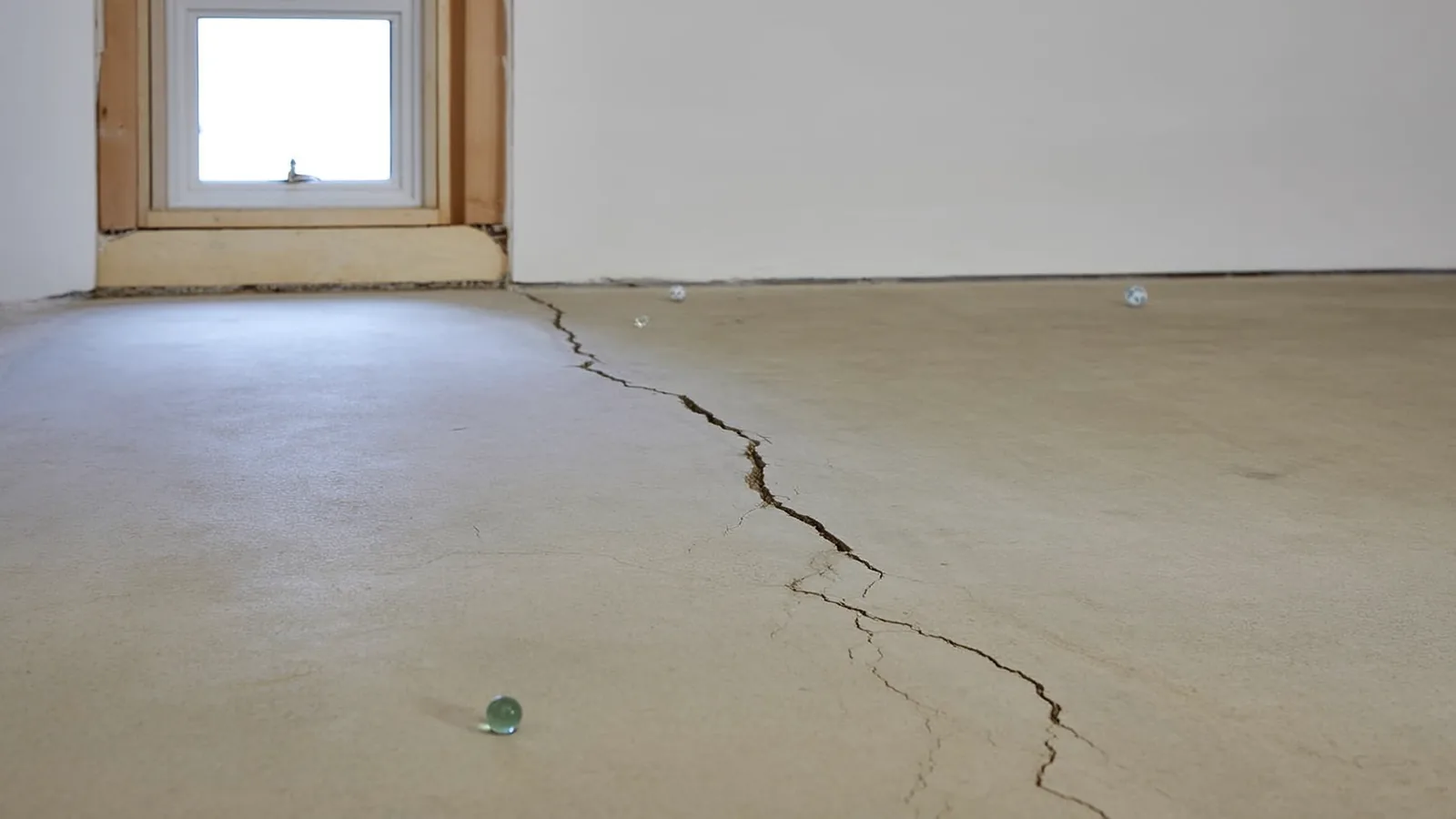
What Floor Cracks Look Like (and When to Act)
A crack in your floor is easy to dismiss. It sits underfoot, often under a rug, and it does not make noise or visibly move. That invisibility is what makes floor cracks one of the most underreacted-to warning signs in residential foundation repair.
What floor cracks look like exactly
Concrete slab cracks show up as thin lines across a poured surface, sometimes running straight, sometimes branching in a pattern that resembles a dry riverbed. The critical details are width, direction, and displacement. A crack less than 1/8 inch wide and perfectly level on both edges is often a shrinkage crack from the original concrete pour. A crack wider than 1/4 inch, a crack running diagonally from a corner, or a crack where one edge sits visibly higher than the other is a different category of problem entirely.
In crawl-space homes, which make up a large portion of pre-2000 construction across Knox County, floor cracking often shows up differently. You may notice wood subfloor boards separating, soft or bouncy spots underfoot, or visible sagging when you look up from the crawl space. Tile floors crack or pop loose from grout lines. Hardwood planks gap or cup. All of these patterns can trace back to the same underlying cause: the foundation below is moving.
Monitor vs. act now
A crack under 1/8 inch wide with no vertical displacement and no change over 90 days of monthly measurement is a candidate for monitoring. Mark both ends with a pencil line and the date, photograph it, and check it again in 30 days.
Move to “act now” if: the crack is wider than 1/4 inch, one side is higher than the other, the crack is growing between measurements, or you see correlated symptoms like sticking doors, wall cracks near windows, or gaps between baseboards and the floor. Any of those conditions suggests active settlement, and active settlement does not fix itself.
What NOT to do
The most common mistake homeowners make is filling the crack with concrete patching compound, epoxy, or caulk and calling it done. This approach hides the evidence a professional uses to track movement and does nothing to address the soil conditions driving the crack. If settlement is still occurring, a filled crack will re-open, sometimes within a single rainy season. Avoid resurfacing floors or laying new tile over a cracked slab until you know whether the foundation below is stable.
What Causes Floor Cracks in Knoxville, TN
Knoxville sits in the Great Appalachian Valley, roughly halfway between the Great Smoky Mountains and the Cumberland Plateau (Wikipedia: Knoxville, Tennessee). That geographic position puts the city in the Valley and Ridge province, where the bedrock beneath Knox County is primarily karst limestone and dolomite with residual clay and silty clay soils above it (USDA Web Soil Survey, Knox County; Tennessee Geological Survey karst mapping).
This geology creates two distinct floor-crack risk factors that do not exist in most other Southeastern metros.
The first is the shrink-swell cycle. Knox County clay soils expand when they absorb water and shrink when they dry out. With nearly 48 inches of annual rainfall (NWS Morristown, KMRX, 1991-2020 Climate Normals) concentrated in spring and winter, followed by dry summers, the soil under a foundation expands and contracts repeatedly. When that movement is uneven, meaning one corner of the foundation settles more than another, the slab or floor structure above it cracks along the lines of stress.
The second and more distinctive risk factor is karst subsidence. Knox County’s documented karst limestone bedrock contains solution cavities and subsurface voids formed over thousands of years of water dissolving soluble rock. When a void collapses or expands, the soil above can drop suddenly, taking a section of foundation with it. According to Wikipedia’s entry on expansive clay, engineering solutions for soil instability include deep foundations or pile systems extending beyond the affected soil depths. That principle applies directly to Knox County’s karst risk. A gradual shrink-swell crack and a sinkhole-related crack can look similar on the surface but require very different responses below grade.
Valley-and-Ridge terrain also concentrates stormwater into low points. Homes in valley positions on Knox County’s rolling terrain often receive runoff from uphill neighbors, saturating soil against foundation walls and below slab edges in ways that amplify the shrink-swell cycle and increase hydrostatic pressure on crawl-space foundations.
Repair Methods That Address Floor Cracks
Treating a floor crack without addressing its cause produces a temporary cosmetic fix. The correct repair depends on what is driving the movement below the floor.
Helical piers
When floor cracks trace back to foundation settlement, helical piers are one of the most reliable long-term solutions in Knox County. Steel piers with helical plates are screwed into the ground past the unstable surface soils and into competent bearing material, which in many parts of Knox County means reaching past the clay layer to bedrock. Because the pier bypasses the shrink-swell zone, it provides stable support that is not affected by wet-dry cycles. Knox County’s karst geology makes bedrock-reaching piers especially important, since shallow support in a karst-affected area can shift if a solution cavity develops underneath. Learn more about how helical piers stabilize settling foundations.
Concrete lifting
When floor cracks in a slab result from voids or low spots beneath a poured surface that has not yet shifted dramatically, concrete lifting can restore the slab to level without full replacement. This method injects material, often high-density polyurethane foam, beneath the sunken section to fill voids and raise the concrete back toward its original position. It works best when the underlying soil is relatively stable and the settlement is limited in scope. Read about concrete lifting as a floor repair option.
Crawl-space repair
For homes with crawl-space foundations, which is the majority of Knox County homes built before 2000, floor cracks often reflect deteriorating support posts, beams, or girders in the crawl space below. Moisture infiltration in an unencapsulated crawl space accelerates wood rot and causes posts to sink into soft soil. Repairs may include installing new steel support columns, sistering damaged joists, or encapsulating the crawl space to control moisture. Explore crawl-space repair methods that address floor sagging and cracking.
Underpinning
Broader foundation underpinning addresses cases where multiple floor cracks indicate widespread differential settlement across a larger section of the foundation. Underpinning adds support beneath the existing foundation, extending it to a more stable soil layer or to bedrock. In Knox County, where shallow bedrock on ridge positions and karst voids in valley positions both complicate uniform foundation bearing, underpinning provides a way to establish consistent support across an uneven bearing environment. See underpinning options for foundations with extensive settlement.
Typical Cost Range
Repair costs vary significantly depending on what is causing the floor crack and how far settlement has progressed. According to Bob Vila’s foundation repair cost guide, crack-only repairs run $250 to $800 per crack. Mudjacking or concrete lifting costs $500 to $1,300. Piering and underpinning run $1,000 to $3,000 per pier, and broader stabilization or reinforcement work ranges from $4,000 to $12,000.
These ranges reflect the method, not the symptom. A homeowner who catches a single isolated slab crack early and needs only one or two piers will pay far less than one who delayed until settlement affected a large section of the foundation. Early professional evaluation is consistently the most cost-effective path. Review the full Knoxville foundation repair cost breakdown to understand what drives pricing for your specific situation.
What a Free Inspection Covers for Floor Cracks
A professional foundation inspection specific to floor cracks follows a structured process. The inspector will:
Measure crack width at the widest point and record it with the date, creating a baseline for tracking future movement. They check for vertical displacement between the two edges of each crack, which is one of the clearest indicators that one side of the foundation has dropped relative to the other. They map the crack pattern across the floor to identify whether damage is localized (suggesting a point-load problem or a single void) or spread across multiple bays (suggesting broader differential settlement).
The inspector also evaluates correlated symptoms: do doors stick in the frames above the cracked area? Are there wall cracks near windows on the same side of the house? Is the floor visibly sloped when measured with a level or manometer? All of these data points help distinguish a surface shrinkage crack from an active structural movement problem.
Outside the home, the inspector looks at grading and drainage patterns, checks downspout discharge locations, and considers the local terrain. In Knox County, a competent inspection should also note whether the site is in a karst-susceptible zone, since the appropriate repair method in a karst-affected area may differ from a standard clay-settlement repair.
You can schedule a no-obligation evaluation through the free foundation inspection request form.
When to Skip Repair (or Wait)
Not every floor crack requires immediate structural repair. Concrete slab cracks under 1/8 inch wide with no vertical displacement, no measurable growth over three or more months of tracking, and no correlated symptoms in walls, doors, or exterior grade are reasonable candidates for ongoing monitoring rather than immediate repair.
Homes with crawl-space foundations sometimes develop minor floor springiness from normal seasonal wood movement rather than structural failure. If the subfloor is dry, the support posts are plumb and solid, and the bouncy section is small and consistent across seasons, a watchful-waiting approach is appropriate.
The honest boundary is this: if you cannot rule out active settlement, if cracks are growing, if multiple symptoms are appearing together, or if your home sits in a part of Knox County with documented karst activity, professional evaluation gives you the information to make the right call. Monitoring is a valid strategy when you have confirmed the crack is stable. It is not a valid strategy when the crack’s status is unknown.
Explore the full range of foundation problems and warning signs to see how floor cracks compare to other symptoms and what each combination of signs typically indicates.