What are helical piers and when are they the right choice?
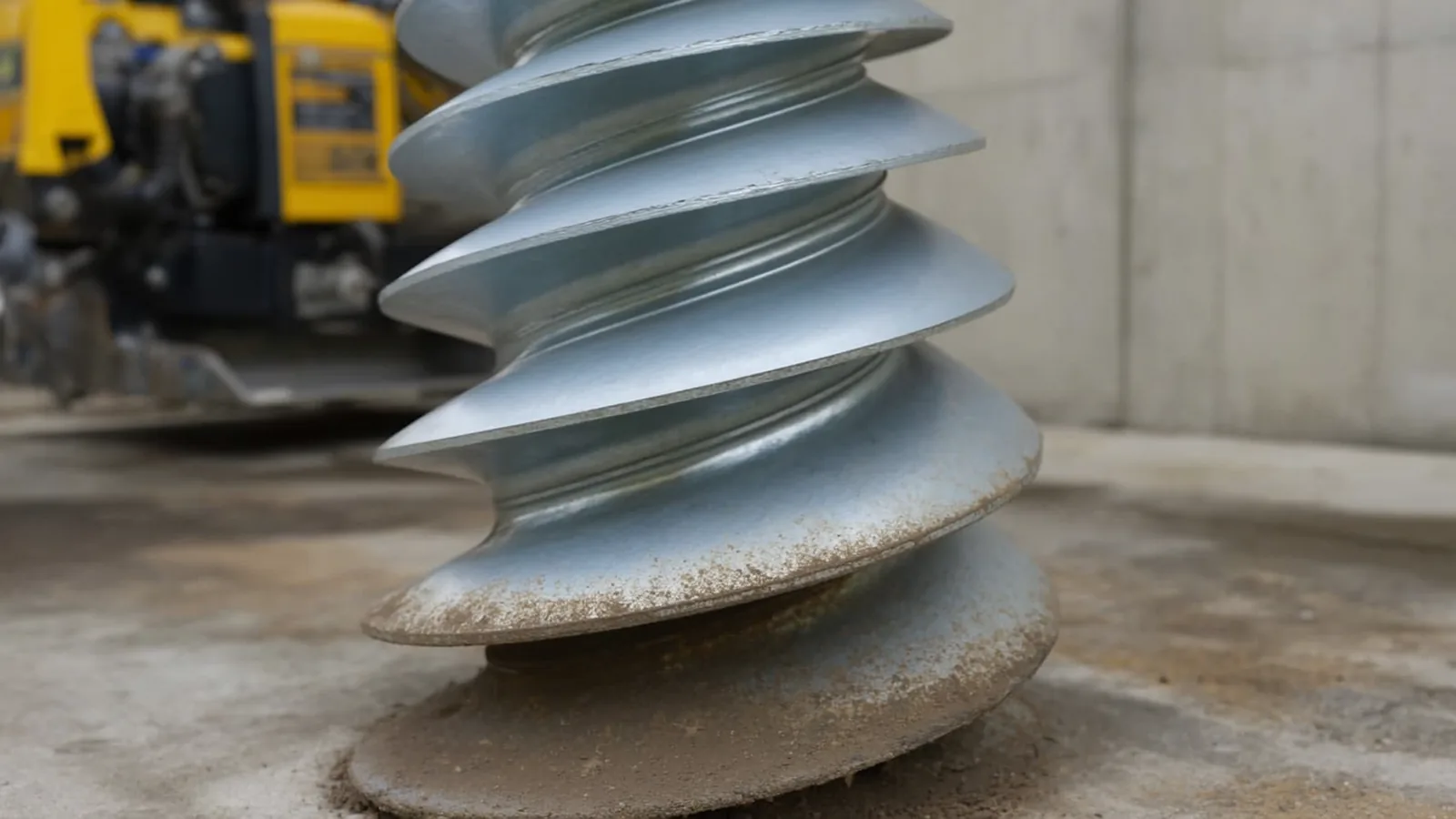
Helical piers are galvanized steel shafts fitted with one or more helical plates, similar in appearance to a large screw. A hydraulic drive head rotates them into the ground until the plates reach load-bearing soil or bedrock. Once installed, a bracket attached to the existing footing transfers the structure’s weight from the failing upper soil layer down to the stable bearing point far below. The process is mechanical, not chemical, which means there is no waiting for grout or concrete to cure before load transfer begins.
In Knox County, helical piers come up repeatedly in engineering recommendations because the local geology presents two distinct threats at the same time: gradual differential settlement driven by moderate-to-high shrink-swell clay in valley positions, and the potential for acute subsidence over the karst limestone solution cavities that run beneath much of the county. Standard shallow repairs address the first problem but are vulnerable to the second. Helical piers advance past both unstable clay and subsurface voids to competent bedrock, giving a reliable bearing point that neither problem can undermine. According to Wikipedia’s entry on expansive clay, engineering solutions for high-plasticity soils specifically include deep foundations or pile systems extending beyond the affected soil depths, which aligns directly with what helical piers accomplish.
How helical piers bear load mechanically
The load capacity of a helical pier is determined during installation by monitoring installation torque. As the plates advance through soil, resistance increases, and torque readings give the installer a continuous real-time correlation to the pier’s load-bearing capacity. When torque reaches the target value associated with the required capacity, the installer stops. This is a significant advantage over methods that rely on depth alone: in karst geology, bedrock depth varies unpredictably, so torque monitoring tells the crew when they have reached competent material regardless of depth.
Helical piers are particularly well-suited to Knox County sites where any of the following conditions are present. Karst limestone geology with documented or suspected sinkhole and void risk is the primary indicator locally. Soft or disturbed fill soils around additions, porches, and garages also favor helical piers because the screw action penetrates weak fill reliably. New construction or additions where the structure is too light to provide hydraulic ram reaction force require helical piers, since steel push piers depend on the weight of the existing structure to drive them. If you are seeing stair-step cracks in brick veneer or diagonal cracks at door corners, the cause is often differential settlement in exactly the soil types where helical piers earn their role.
Conditions where an alternative may be a better fit
On sites with uniform, cohesive soil and a heavy existing structure, steel push piers can reach refusal depth faster and at slightly lower cost per pier because the hydraulic ram transfers energy more efficiently in those conditions. If the foundation is a heavy slab on a flat-lot home in West Knox post-2000 construction, and the soil profile is consistent without void concerns, the steel push pier method is worth comparing on cost. The honest trade-off is installation efficiency vs. soil-specific reliability.
Installation process
A typical helical pier job on a Knoxville crawl-space home runs one to three days. Here is what to expect at each stage.
1. Site assessment and pier layout (Day 1, morning)
The crew marks pier locations based on the engineering plan, which identifies where load transfer is needed. On crawl-space homes, access points or vents are confirmed. Excavation is limited to small pits at each pier location, typically two to three feet across.
At each pier location, the installer exposes the footing edge, cuts away a small section of concrete if needed, and attaches a steel bracket. This bracket is the mechanical connection between the pier shaft and the structure once load transfer is complete.
3. Rotary installation to torque target
A compact hydraulic drive head, which fits through standard crawl-space access on most pre-2000 Knox County homes, rotates the lead section into the ground. Extension shafts are added as depth increases. The crew monitors torque continuously. In karst areas this process can involve passing through voids before reaching bedrock, and the torque monitoring catches that transition. When the target torque is reached at each location, that pier is complete.
4. Load transfer and optional lifting
Once all piers are installed, hydraulic jacks apply upward pressure through the brackets simultaneously. The goal is stabilization first. Lifting to recover some of the original elevation is attempted where the structural condition permits, but partial recovery is common on older foundations where full return to original grade would stress finished interior surfaces.
5. Backfill, cleanup, and documentation
Pits are backfilled and compacted. On crawl-space homes, interior work requires no surface excavation at all. The contractor documents final torque readings, pier depths, and bracket positions for the warranty and permit file.
Helical piers vs. steel push piers
Both methods move a foundation’s load past failing soil to a deeper bearing point. The difference is in how force is applied and what soil conditions each handles well.
Helical piers use rotational torque and do not need the weight of the structure to advance. This makes them usable under light structures, porches, additions, and new construction, and it makes them the default choice in Knox County’s karst geology where a consistent refusal depth cannot be assumed in advance. The helical plates also provide tension capacity, meaning the pier resists being pulled upward as well as pushed downward, which matters on sites where expansive clay can exert upward heave pressure.
Steel push piers advance by hydraulic force reacting against the structure’s own dead load. On a heavy slab home on uniform soil, this is efficient and cost-competitive. The push pier can reach deeper bedrock on uniform sites without the extension shaft accumulation that adds cost to helical installations on deep-bedrock sites. But if subsurface voids exist, a push pier can advance past a void into a zone with no bearing capacity before the operator realizes the problem. Torque monitoring on helical piers catches this.
For most Knoxville buyers dealing with older crawl-space homes in valley positions where karst geology is the background condition, helical piers are the lower-risk choice even if the per-pier price is comparable. On flat-lot post-2000 West Knox slabs with no known karst history, getting a comparison estimate for steel push piers in Knoxville is reasonable.
Helical pier cost in Knoxville, TN
Bob Vila’s foundation repair cost guide puts piering and underpinning at $1,000 to $3,000 per pier installed. Total project cost depends on how many piers the engineer specifies, which is driven by the foundation’s load distribution and the pattern of settlement. A modest crawl-space home with localized corner settlement may need as few as four to six piers. A large home with perimeter-wide differential settlement may require twelve or more.
Several local variables move the final number. Depth to competent bedrock is the largest factor in Knox County. Karst geology means bedrock can be close to the surface on ridge positions and unexpectedly deep in valley positions where solution weathering has lowered it. More extension shafts mean more material and labor. Access difficulty is the second variable: piers under a tight interior crawl space or below a concrete porch slab require more setup time. Permit and engineering fees add a fixed cost layer regardless of pier count.
For a detailed breakdown of what drives the final number on a Knox County project, see the helical pier cost guide for Knoxville.
If you are ready to get pier locations and counts assessed for your specific home, request a foundation inspection and written estimate.
Warranty and transferability
A warranty on helical pier work has two components: the manufacturer’s coverage on the steel pier material itself and the contractor’s workmanship warranty on the installation. Strong warranties unify both into a single document and state a term of at least 25 years. Transferability to a subsequent buyer, at no additional charge, is the market standard and should be written explicitly into the contract rather than implied.
Ask specifically whether the warranty covers renewed settlement at the pier locations. Some warranties cover pier failure but exclude renewed settlement caused by adjacent soil movement. In Knox County, where karst activity can cause soil migration laterally around a pier, this distinction matters. Also ask whether the contractor is an authorized installer for the pier manufacturer, since warranty claims on the material often route through the manufacturer rather than the contractor.
Documented installation records, including torque logs for each pier and depth at termination, serve as the evidence base for any future warranty claim. A contractor who does not provide this documentation at project close is a contractor whose warranty is difficult to enforce.
Permits and engineering in Knox County
Foundation underpinning is a structural repair and requires a building permit in Knox County, Tennessee. Permit authority falls under Knox County Building Codes and the City of Knoxville Permit and Inspections Division for properties within city limits. Tennessee adopted the International Residential Code under TCA 68-120-101 and Rule 0780-2-2, and structural repairs including underpinning fall under that framework.
For properties within the City of Knoxville, permits are issued through the City of Knoxville Development Services Division, One Civic Plaza, Knoxville, TN 37902. For unincorporated Knox County properties, permits go through Knox County Building and Codes, 400 Main Street, Suite 425, Knoxville, TN 37902. Confirm jurisdiction by address before applying, since the Knox County metro includes municipalities like Farragut and Powell that may have their own permit routing.
A structural engineer’s letter or stamped plan set is typically required for underpinning permits. The engineer specifies pier locations, depths, and load targets based on a site visit. Reputable contractors in the Knoxville market coordinate the engineering scope as part of their project process rather than leaving the homeowner to find an engineer independently. Confirm this during the estimate stage.
For homeowners in the broader Knoxville service area, including surrounding counties where the Valley-and-Ridge geology and karst conditions extend well beyond Knox County’s boundaries, local foundation repair service information for the Knoxville metro covers the geographic scope of what to expect.