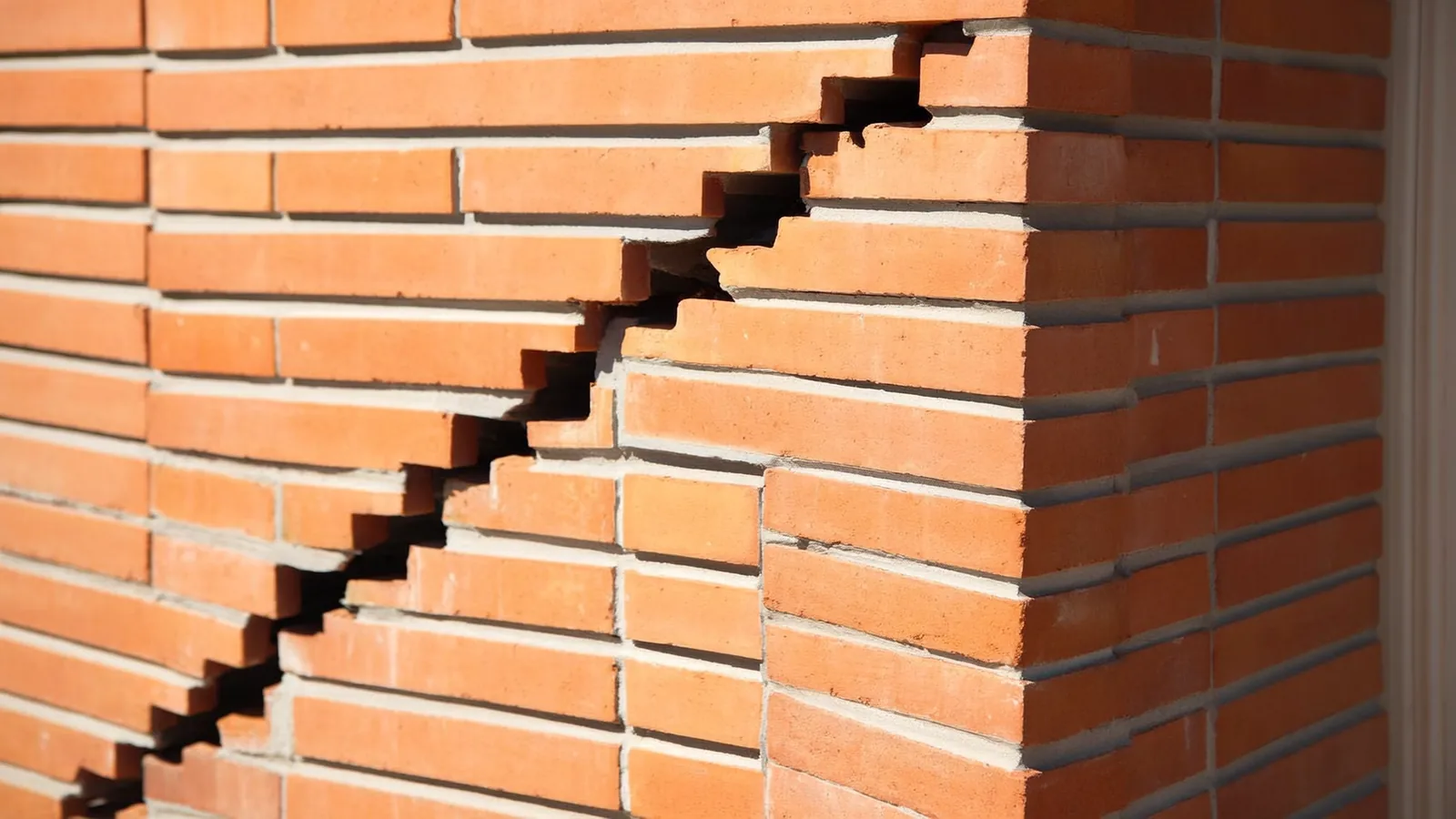
What Stair-Step Cracks Look Like (and When to Act)
Stair-step cracks are diagonal fractures that follow the mortar joints of a brick or concrete block wall, zigging and zagging like a staircase from one course to the next. They are most visible on exterior brick walls, basement block walls, and the mortar joints of crawl-space foundation walls. They look different from horizontal cracks (which signal bowing pressure) and from random diagonal cracks in drywall, and that difference matters for diagnosis.
What They Look Like Exactly
The crack travels along the mortar bed between bricks or blocks rather than cutting through the masonry units themselves. A fresh crack may appear as a thin gray line barely wider than a pencil mark. A more serious crack will show displacement, meaning one side of the crack sits higher or lower than the other, and the mortar gap may be wide enough to slip a coin into. In advanced cases, the bricks or blocks themselves begin to fracture, and the wall may visibly bow outward at the base or the top.
Monitor vs. Act Now
Treat a crack as a monitoring situation when it is hairline width (under 1/16 inch), limited to a single short section, and has shown no change over two or three wet-dry seasonal cycles. Take photos with a ruler in frame and check monthly.
Treat a crack as act-now when any of the following are true: the opening exceeds 1/4 inch, you can feel displacement when you run your hand across the crack, the wall is visibly leaning or bowing, the crack runs through the brick faces rather than only the mortar, windows or doors in the affected area have begun sticking or racking, or the crack appeared suddenly rather than gradually. A sudden appearance, especially in Knoxville’s karst terrain, can signal subsidence over a solution cavity rather than slow clay-driven settling.
What NOT to Do
Do not caulk or repoint stair-step cracks before a structural evaluation. Cosmetic mortar repairs hide the evidence an inspector needs to track movement and often fail within one season. Do not assume a small crack is harmless simply because the wall looks otherwise intact. Do not hire a general masonry contractor to patch cracks without first confirming that a foundation specialist has reviewed the underlying cause.
What Causes Stair-Step Cracks in Knoxville, TN
Knoxville sits in the Great Appalachian Valley, roughly halfway between the Great Smoky Mountains and the Cumberland Plateau, at elevations ranging from about 800 feet at the Tennessee River to over 1,000 feet on the western hilltops (Wikipedia: Knoxville, Tennessee). That geography creates a specific combination of soil and geological conditions that make stair-step cracking one of the metro’s most common foundation complaints.
The primary soil type in Knox County’s valley positions is residual clay and silty clay formed from the weathering of limestone, dolomite, and shale (USDA Web Soil Survey, Knox County, Tennessee). These soils have moderate-to-high shrink-swell potential. When Knoxville’s nearly 48 inches of annual rainfall (NWS Morristown, KMRX, 1991-2020 Climate Normals) saturates the clay, it expands and pushes unevenly against footings. When dry summer weather follows, the clay contracts, removing support in patches rather than uniformly. Foundations that settle more on one corner or one side than the other experience differential movement, and stair-step cracking is the masonry’s way of releasing that stress.
Knox County’s karst limestone geology adds a second risk that is largely absent in other Southeastern markets. The Tennessee Geological Survey has documented extensive karst features across the county, including sinkholes, solution cavities, and subsurface voids in the bedrock. When a void enlarges or a shallow cavity collapses, even partially, the ground above it can drop suddenly rather than settling gradually. Foundations over these areas may show stair-step cracks that open faster and with more displacement than clay-settling patterns alone would produce.
The Valley-and-Ridge terrain also concentrates stormwater at valley positions. Homes at the base of a slope receive not only their own rainfall but runoff from higher ground, keeping soils wetter longer and accelerating the wet-dry cycle. Many pre-2000 Knoxville homes were built without the deep drainage design that this terrain demands. Combine that with a median construction year of 1974 and the reality that a large share of Knox County homes have original foundations more than fifty years old, and the conditions for stair-step cracking are well established.
Repair Methods That Address Stair-Step Cracks
The right repair depends on what is driving the movement. A structural inspection identifies whether the issue is gradual clay settlement, a karst-related void, lateral wall pressure, or some combination.
Helical Piers. When differential settlement is the cause, extending the foundation’s support down to stable bearing material stops further movement. Helical piers driven to competent bedrock are frequently the preferred underpinning method in Knox County’s karst-limestone terrain because they can be advanced through soil voids and anchored below them rather than within unstable material. The piers are installed from the exterior, typically without heavy excavation, and are well suited to the tight lot conditions common in older Knoxville neighborhoods.
Push Piers. For heavier loads or situations where deep bedrock requires a driven-steel solution, push piers offer an alternative underpinning path. Like helical piers, push piers transfer load past the problem soil layer to a stable bearing stratum. The choice between helical and push piers depends on soil conditions, load, and access, which the inspection determines.
Wall Anchors. When a stair-step crack is paired with a bowing or tilting basement or crawl-space wall, the wall itself needs restraint, not just the footing. Wall anchors are steel plates installed in the soil outside the wall and connected by a rod to an interior plate, counteracting the lateral forces pushing the wall inward. They are often used when clay expansion or hydrostatic pressure is the primary driver of wall movement.
Carbon Fiber Straps. For walls showing early-stage bowing or flex without significant displacement, carbon fiber straps bonded vertically to the wall’s interior surface can stabilize the wall and prevent further inward movement. They are less disruptive to install than anchor systems and work well when movement is caught early.
Typical Cost Range
Repair costs for stair-step crack situations vary considerably based on the number of piers or anchors required, the depth to stable bearing material, and the wall conditions found during inspection. According to Bob Vila’s foundation repair cost guide, crack injection alone runs $250 to $800 per crack, underpinning with piers runs $1,000 to $3,000 per pier, and full stabilization or reinforcement projects range from $4,000 to $12,000.
Knoxville-area projects that require reaching bedrock through karst terrain may fall toward the upper end of the piering range, since depth to competent rock varies unpredictably across the county. For a full breakdown of what drives foundation repair costs, see our foundation repair cost guide.
Inspection Process
A professional foundation inspection for stair-step cracks covers several specific measurements and observations that go beyond a visual walk-around.
The inspector will measure crack widths at multiple points using feeler gauges or a crack comparator card and record whether displacement exists at the crack face. Photographs are taken with measurement references to establish a baseline for future comparison.
Elevation readings are taken at multiple points along the affected wall and at interior floor locations to map where differential settlement has occurred and in which direction the foundation is moving. This elevation survey is what distinguishes a settlement crack from a crack caused by soil heave (upward movement), and the two require different repairs.
In Knox County’s karst terrain, a competent inspector will also ask about any history of sinkholes on the property or on adjacent lots, look for depression patterns in the yard that could indicate a shallow void, and note whether crack patterns suggest a localized point failure rather than a gradual settling across the building.
The inspection report will identify the probable cause, the current severity, and the recommended repair method with the number and placement of any piers or anchors required. Reach out through our free inspection request to schedule an on-site evaluation.
For more context on the full range of foundation warning signs, see the foundation problems overview.
When to Skip Repair (or Wait)
Not every stair-step crack requires immediate intervention. Monitoring is appropriate when cracks are hairline width, confined to one small section, and have shown no measurable change over two full seasonal cycles (roughly spring wet season through late-summer dry period). In that situation, an inspector may recommend marking the crack ends with pencil and date, photographing monthly, and returning for a follow-up evaluation in six to twelve months.
Repair can also be deferred when the cause is confirmed as original construction settling that concluded decades ago rather than ongoing movement. Some Knoxville homes built in the 1950s and 1960s settled during their first few years and have remained stable since, with old cracks that were repointed at some point and have not reopened. If the inspection confirms no active movement and no karst risk in that location, monitoring and cosmetic repointing may be the reasonable path.
What is never appropriate is assuming stability without measuring it. The combination of Knox County’s shrink-swell clay and karst bedrock means that a crack that looks stable in February may behave differently after a heavy spring rain or a long dry July. Measurement and documentation are the only reliable way to confirm a crack is truly dormant.